Henry Ford by The Editors of New Word City
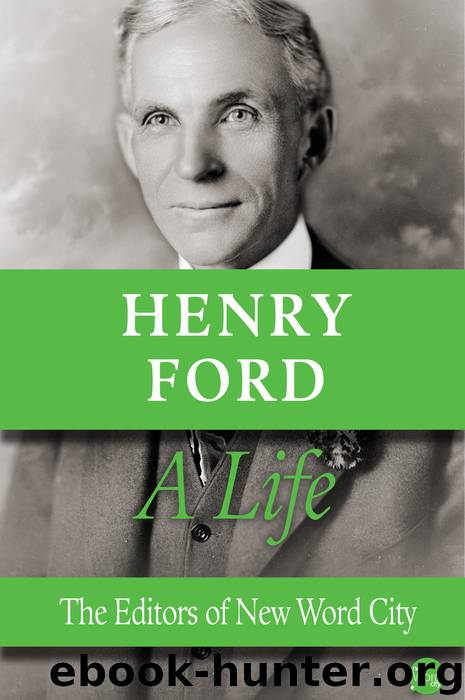
Author:The Editors of New Word City [The Editors of New Word City]
Language: eng
Format: epub
ISBN: 9781612307169
Publisher: New Word City, LLC
Published: 2013-03-29T16:00:00+00:00
A Homespun Tycoon Puffs Up
Ford was now arguably the most famous person on the planet, on his way to becoming the first billionaire. To some, he represented a new force in the world: “Fordism” (“Fordismus” in German), a quintessentially American mix of energy, scale, standardized production, and optimism. But he maintained the homespun style of a Midwestern farm boy. When he visited J.P. Morgan’s New York mansion, he commented: “It’s very interesting to see how the rich live” - ignoring the fact that, by then, he was far wealthier than Morgan. He told an interviewer that he didn’t want servants in his house, saying that he liked boiled potatoes with their jackets off, and he didn’t want someone snickering behind him while he peeled the skins. He said calloused and work-worn hands were a sign of virtue while the “soft white hands” of bankers and financiers were to be distrusted.
Initially appealing, this parochialism also had its underside. Half-educated in a one-room country schoolhouse, Ford was wary of “book learning,” formal management techniques, and even accounting. He kept his balance sheet on the backs of envelopes and refused to have his company’s books audited. He pitted managers against each other and had a penchant for practical jokes that were more cruel than funny: He drove one executive to resign by moving his desk into the men’s room.
And as fame and adulation washed over him, the farm boy succumbed to it. Ford basked in the company of men like Thomas Edison and Harvey Firestone and tossed off maxims for the benefit of humankind: “History is more or less bunk.” “Failure is only the opportunity to begin again more intelligently.” To make sure his workers didn’t fritter away the fruits of their $5 days, he set up a “sociological department” with fifty staffers assigned to visit the workers in their homes, inspecting for the use of alcohol and tobacco and handing out pamphlets urging them not to spit on the floor.
Once reticent about commenting on subjects beyond autos and engineering, Ford became an oracle on everything from international diplomacy and the gold standard to evolution and reincarnation. Opposing war as a waste of time and talent, he funded a “Peace Ship” to carry himself and 170 leading pacifists to Europe in 1915 with their stated purpose to end World War I. But when he became the focus of widespread ridicule, he jumped ship at the first stop in Sweden. Even so, he blamed global war financiers for secretly planning the sinking of the liner Lusitania “to get this country into war.”
Ford’s goals for his company became ever more ambitious. He pioneered the practice of vertical integration, taking on every aspect of auto production. He owned iron and copper mines in northern Michigan and Minnesota, and a fleet of ships to transport the ore to Detroit. He owned a railroad, sixteen coal mines, and thousands of acres of timberland. In his one undeniable failure, he spent $20 million over nearly twenty years on the hapless Fordlandia project to produce his own rubber in the Brazilian jungle.
Download
This site does not store any files on its server. We only index and link to content provided by other sites. Please contact the content providers to delete copyright contents if any and email us, we'll remove relevant links or contents immediately.
Hit Refresh by Satya Nadella(9091)
When Breath Becomes Air by Paul Kalanithi(8386)
The Girl Without a Voice by Casey Watson(7855)
A Court of Wings and Ruin by Sarah J. Maas(7758)
Do No Harm Stories of Life, Death and Brain Surgery by Henry Marsh(6916)
Shoe Dog by Phil Knight(5231)
A Higher Loyalty: Truth, Lies, and Leadership by James Comey(4925)
The Rules Do Not Apply by Ariel Levy(4919)
Hunger by Roxane Gay(4901)
Tuesdays with Morrie by Mitch Albom(4740)
Everything Happens for a Reason by Kate Bowler(4708)
The Immortal Life of Henrietta Lacks by Rebecca Skloot(4561)
Millionaire: The Philanderer, Gambler, and Duelist Who Invented Modern Finance by Janet Gleeson(4432)
How to Change Your Mind by Michael Pollan(4325)
All Creatures Great and Small by James Herriot(4286)
The Money Culture by Michael Lewis(4150)
Man and His Symbols by Carl Gustav Jung(4108)
Elon Musk by Ashlee Vance(4096)
Tokyo Vice: An American Reporter on the Police Beat in Japan by Jake Adelstein(3957)
